Aims and scope
The CRACKHINIT project is a project for young researchers funded by the French Research National Agency (ANR) through the contract ANR-17-CE08-0023-01. It is realised at the Laboratoire des Sciences de l'Ingénieur pour l'Environnement - UMR CNRS 7356 - located in the university of La Rochelle, France.
Context
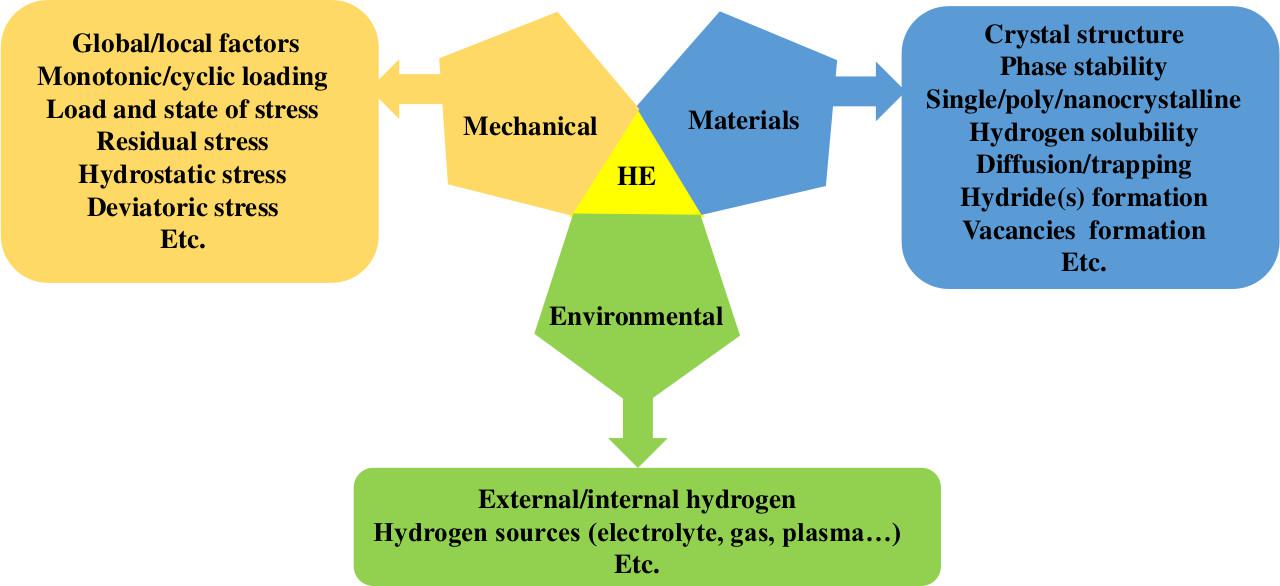
The materials are continuously exposed to hydrogen, which is everywhere in our atmosphere and in our environment. This solute can interact easily with the metallic structures due to its small size and its chemical properties, and can lead to a prematurely embrittlement. This latter is an additional constrain in the design of metallic structures in order to assure the integrity and the safety of the industrial facilities. In fact, this process called hydrogen embrittlement is a major cause of failures in the industry (harbor, nuclear, pipe-lines, petrochemistry...). Therefore, this form of stress corrosion cracking has many consequences for security and economic issues. In addition, hydrogen embrittlement process is related to the societal field of sustainable development. Actually, a precise knowledge of this phenomenon can permit the design of new manufacturing processes and/or new materials able to lowering the risk of failures and, therefore, to increase the useful life of the metallic structures, industrial facilities but also the fuel cells.
The rough character of failures and its human and economic consequences are the inspiration of many projects and publications since the discovery of the HE phenomenon in the XIX th century. However, the basic mechanisms associated to the coupling between hydrogen diffusion and solubility and the action of an external stress remain unexplored due to the complexity of the processes and the difficulty in the modeling of the phenomenon. The clarification of the effects due to the combined action of the H incorporation and diffusion in a material and an external stress remains experimental and theoretical barriers in the development of new technologies. In other words, even the embrittlement mechanisms are well identified, the kinetic and thermodynamic origins of the hydrogen embrittlement under stress remain unclear.
Objectives
Since the complete description of the hydrogen embrittlement phenomenon involves a wide range of size and time scales, we have decided to limit the study to the interactions between the solute and a surface during fatigue tests. The fatigue tests consist of a cyclic deformation of the material, which reproduce a part of the operating conditions of the metallic structures. During the tests, crystalline defects such as vacancies and dislocations are produced and contribute significantly to the fatigue properties of the material. In addition, the presence of hydrogen affects the fatigue behavior of metals and lead to fatigue corrosion processes. A large number of works and reviews in the fatigue community have highlighted the importance of the vacancy formation and mobility and their interactions with adsorbed solutes on the cyclic crack initiation. The resistance of the materials to corrosion fatigue is closely linked to the adsorption of hydrogen on the steps created by the slip bands at the surface and to the ability of the solute to diffuse inside the bulk material in this situation. The potential of hydrogen to be adsorbed and to diffuse is related to the interactions occurring at the atomic scale between the solute and the crystalline defects (surface, vacancies, dislocations). Therefore, the goal of the project is a clarification of the basic mechanisms occurring at the atomic and at the intra-granular scales of the hydrogen-surface-vacancy interactions in nickel under fatigue. Here, the chosen material is fcc nickel for its common applications in industry and it is widely studied in our laboratory (structure, defects...). In particular, the scientific objectives focused on:
- The H adsorption at the surface and the absorption in the subsurface layers with or without the presence of steps created by slip bands.
- The H diffusion in the subsurface layers with or without the presence of the step.
- The effects of vacancies and an external stress on the two phenomena given above.
Strategy
The project aims to contribute to a better understanding of one of the corrosion fatigue processes occurring at the atomic scale in relation with hydrogen embrittlement. The elementary phenomena in corrosion fatigue are investigated at the finest scales, since previous studies have been limited at the macroscopic scale only, from a combination of experimental and numerical techniques. The results are discussed to put in forward the most significant effect (H flux, vacancy formation...) implied on the degradation of the fatigue properties. The success of the project can be achieved from the development of original approaches and methodologies including: - The emergence of atomic scale calculations in context of fatigue. Up to now, the studies devoted to the hydrogen-surface interactions at the atomic scale are limited to metallic surfaces without defects. The project brings a new methodology to treat the solubility and the diffusion of a solute at the surface with the presence of a step created by plastic deformation. In addition, the ab initio calculations conducted during the project in order to determine the solubility and the diffusion coefficient will be done at finite temperature to catch the lattice vibration and electronic excitations effects on these thermodynamic quantities. The novelty of the approach is the use of atomic scale calculations in the context of a material under fatigue and corrosion processes. In addition, these calculations take into account the H-defect interactions and diffusion at finite temperature, which are usually limited to 0 K or with large uncertainties and also the effects of the stress state. - The development of in situ electrochemical permeation and pulse techniques on single crystals under fatigue in a defined thermodynamic state (P,T). The adsorption processes, as well as the diffusion and the absorption in the subsurface layers, are questioned using classical stationary and un-stationary electrochemical techniques for different surface states and vacancy concentrations. The in situ conditions permit to extend our study from stationary conditions to hypothetic out-of-equilibrium situations of the system.